Building regulations for temporary buildings
The most common questions about temporary buildings, alongside building permits, revolve around the area of building regulations. Companies looking for a temporary building usually ask which building regulations must be complied with and why it is so important to obtain the most durable building with structural analysis optimised for the intended location.
We shed some light on the topic of building regulations and provide you with expertise on structural safety, structural analysis for building construction and the stability of the structure, as well as snow and wind load zones in Germany.
Structural engineering in building construction: structural analysis of aluminium structures
To check the safety and load-bearing capacity of a planned building in advance, structural calculations are essential. Many different factors are taken into account: What is the self-weight? Will it be constructed as a temporary structure in accordance with EN 13782 or as a permanent structure in accordance with EN 1991? Where will the building be erected? What snow and wind loads act on the building?
By verifying the structural analysis of aluminium structures, it is ensured that the building’s stability is guaranteed under the consideration of various loads. This task is carried out by publicly appointed independent expert inspectors. Once the assessment is completed, the client receives a structural report as a written, documented proof.
In the course of structural calculations, many companies ask whether planning permission is required for the erection of the building. If it is a permanent structure in accordance with DIN EN 1991, planning permission is always required. If a temporary building is used on a permanent basis, it is also subject to approval.
However, temporary buildings can also be erected as a “temporary structure” and are then, in many cases, exempt from planning permission. In such cases, the building must not exceed a maximum duration of three months, or in some federal states up to six months. Its floor area must not exceed 75 m², although many federal states permit a larger maximum floor area of 100 m².
The wind and snow loads acting on a building at its specific location are essential for structural analysis in building construction:
Wind loads: building wind-resistant temporary buildings
Temporary buildings must withstand horizontally acting loads such as wind. Depending on the location, this wind force acting on a building can vary significantly. In Germany, there are a total of four different wind load zones. DIN EN 1991-1-4 regulates the determination of actions on structures due to natural wind. If a building complies with this standard, you can be confident that your building is designed for the local wind load zone.
Snow loads: securing temporary buildings against snow pressure
Snow is considered a vertical load acting on a building and therefore plays a very important role in the structural analysis of aluminium structures depending on the location. In particular, the roof shape plays a major role in snow loads. For the calculation of buildings, DIN EN 1991-1-3 is used to determine snow load values.
At HTS TENTIQ, we assess all our enquiries and already calculate the required wind and snow loads as part of the quotation process.
Fire protection in building construction: protecting commercial buildings against fire
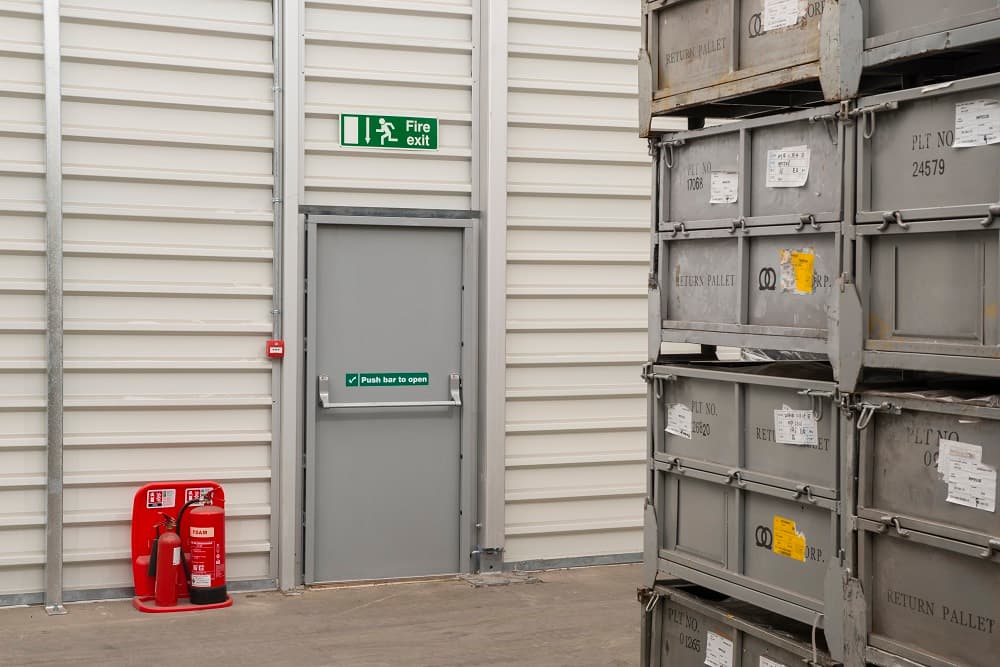
Fire protection that must be taken into account already at the planning stage of a building is essential. The regulations are set out in the building law of the federal states. Fire protection requirements can be very complex depending on the type of commercial building. Depending on the intended use, size, and number of people present in the building, fire protection requirements also increase. Precise planning of fire protection carried out by experts, as well as the preparation of a fire protection report, are essential for safe fire protection in building construction.
A decisive factor for effective fire protection in building construction is the materials used. In German-speaking countries, the fire resistance of construction materials and building products is regulated by the fire protection standard DIN 4102. This standard classifies all construction materials and building products into five different material classes, from A1 (non-combustible) to B3 (easily flammable). Aluminium used in the construction of temporary buildings is considered non-combustible. For our membranes, we use PVC, which is classified under fire protection class B1 according to DIN 4102. These membranes are therefore considered flame-retardant. In addition, the membranes from HTS TENTIQ comply with international standards such as BS 5438 / 7837.
DIN 4102 also classifies building components into four different fire resistance classes: fire-retardant (F30), highly fire-retardant (F60), fire-resistant (F90), or highly fire-resistant (F120/F180). These fire resistance classes indicate how many minutes a component can withstand fire. Components in the fire-retardant class (F30) can therefore be exposed to fire for 30 minutes without losing their function. Temporary buildings from HTS TENTIQ are standardly manufactured without a fire resistance class (F0), but are non-combustible. Individual material requirements can be taken into account as needed.
Sound and thermal insulation: important factors in the construction of buildings
Building regulations also set out certain requirements regarding sound and thermal insulation. However, these are regularly updated, which is why it is always advantageous to have reliable expertise in building construction when planning a building. At HTS TENTIQ, you can be confident that we ensure the best quality for your building while complying with all applicable building regulations.
Do all temporary buildings comply with these regulations?
Reputable suppliers of temporary buildings exclusively offer buildings that comply with the building regulations of the respective country or region. However, temporary buildings from rental stock can be problematic. They often consist of components and fastening elements that do not fit together, and have old frames that have been in use for decades and whose structural integrity must be seriously questioned.
Since it is often impossible to determine the age of a building from rental stock, there are compelling reasons to avoid such structures entirely and to opt for a new building in every case in order to fully comply with building regulations—regardless of whether you intend to purchase or rent. For these reasons, we manufacture exclusively on a made-to-order basis: every building is individually newly produced.
At first glance, the quality of the framework is usually only immediately recognisable to experts. This is because the frame of a conventional tent looks very similar to that of a temporary building. However, this is misleading. The profile thickness is significantly lower and lighter and is not suitable for long-term and safe use. They certainly do not come anywhere close to meeting all regulations.
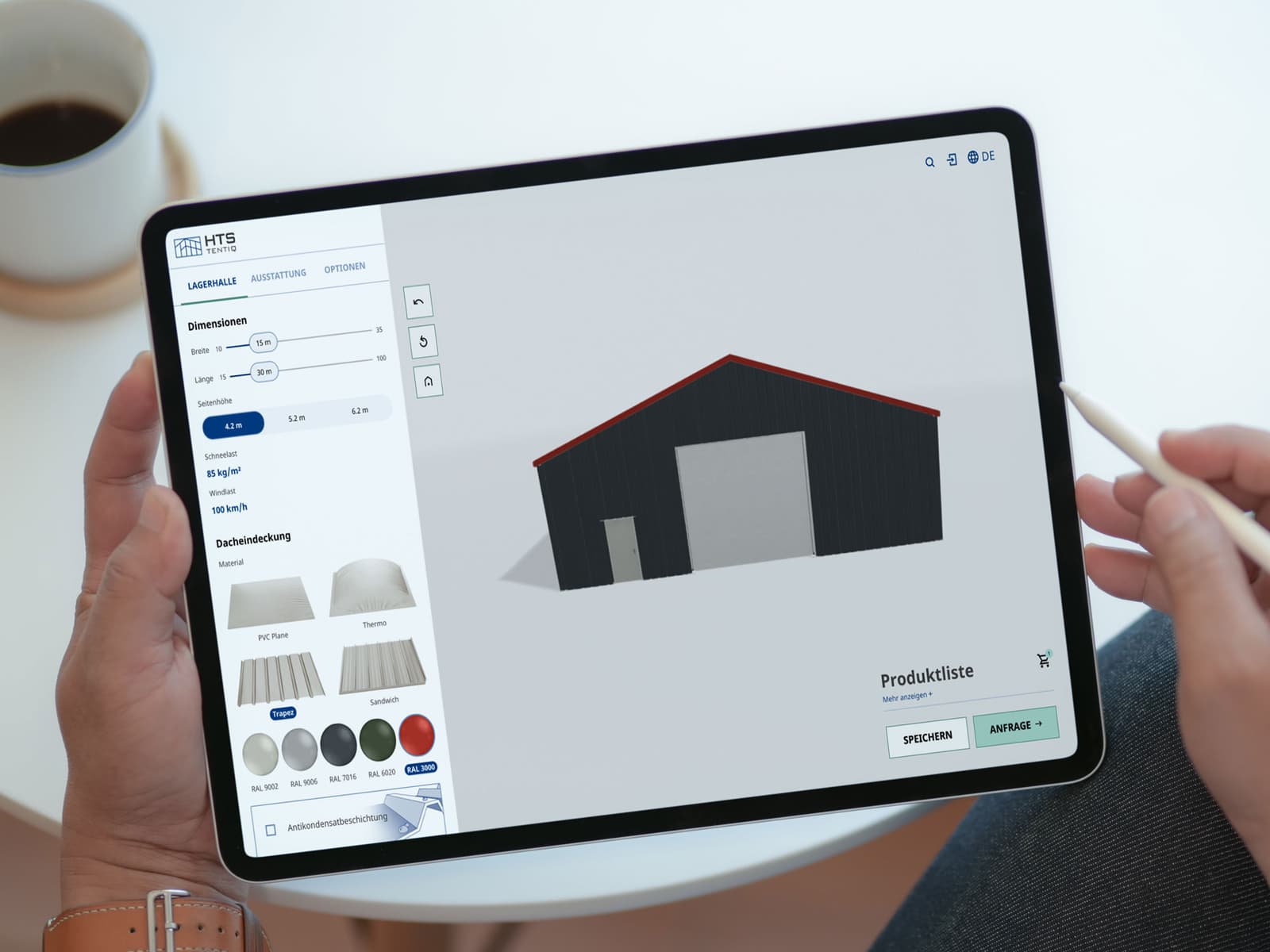
In our configurator you will find the right product for every requirement. Configure your tent system online now and receive your individual quotation.
How to ensure that your temporary building complies with building regulations
The best approach is to purchase a new building directly from the factory and have it specifically manufactured for your location and requirements.
HTS TENTIQ goes even further and designs a temporary building for you that not only complies with general building regulations but also meets the structural calculations required for the specific location. This applies in particular to sites at higher altitudes or in coastal regions, which are additionally exposed to higher wind loads. Any photovoltaic systems are also included in the planning of the building as additional loads. When erecting a temporary building without foundations, the subsoil is carefully assessed in order to select the best and most stable option for anchoring ground pegs or anchors.
Building regulations: why compliance is important
Compliance with building regulations ensures safety. It also delivers quality, durability, and sustainable business success. In addition, full compliance with all regulations secures approval from the local building authority and prevents the possible dismantling and removal of the structure.
Despite these many advantages of complying with building regulations, it is still evident that many companies and suppliers continue to take the easiest route in order to save costs. The short-term savings achieved by purchasing an unapproved and, in a sense, vulnerable structure can, in the worst case, become very costly: accidents, potentially even fatal, can mean the end of a business acting negligently. In addition, there may be damage to existing assets up to total loss, delayed delivery times, or a loss of trust from customers.
Nevertheless, some companies continue to accept these risks. At HTS TENTIQ, we do not take on such incalculable risks.
Compliance with all building regulations: highest quality and safety with temporary buildings from HTS TENTIQ
Our company ethos is based on quality and safety and begins with our products: our structures and workmanship. We also tailor your building to your needs and ensure that your temporary building complies with all building regulations. We accompany you through all stages up to the completed structure and provide support wherever you need it. Experienced structural engineers are involved in our joint project.
As we are both manufacturer and supplier to the industry, our high quality and safety are not reflected in high prices. We are able to offer the safest and most durable temporary buildings at attractive wholesale prices, which are also designed and developed according to site-specific and project-specific requirements.