Temporary building or steel building: which building type is the right one?
Both temporary buildings and steel buildings offer ideal logistics solutions. Both materials, aluminium and steel, meet the requirements of modern industrial buildings. However, they differ significantly in their properties.
We therefore take a closer look at the advantages and disadvantages of these storage marvels for you.
What is the difference between temporary buildings and steel buildings?
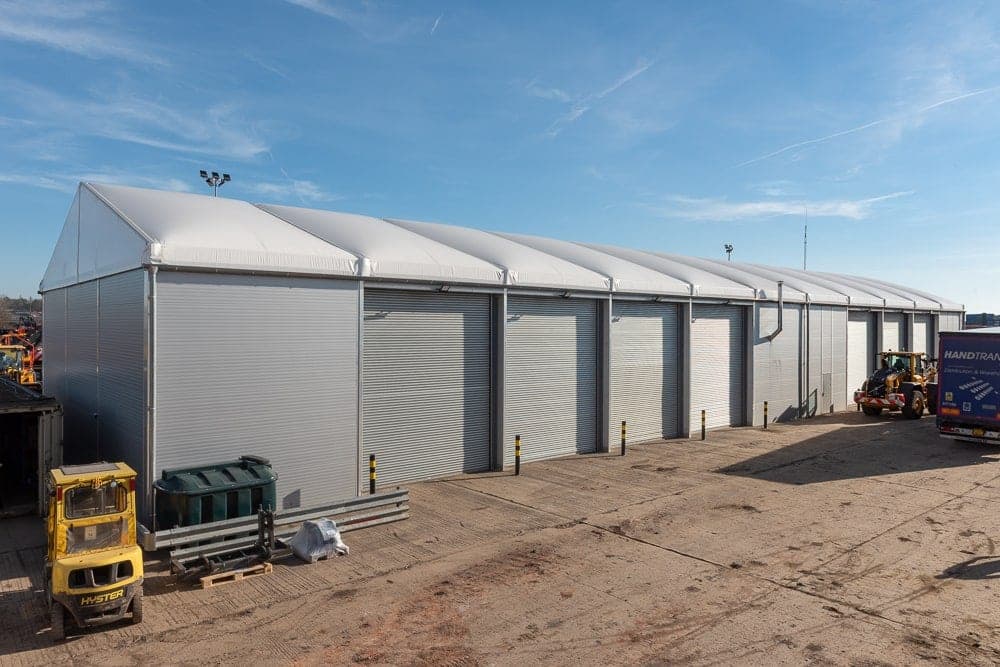
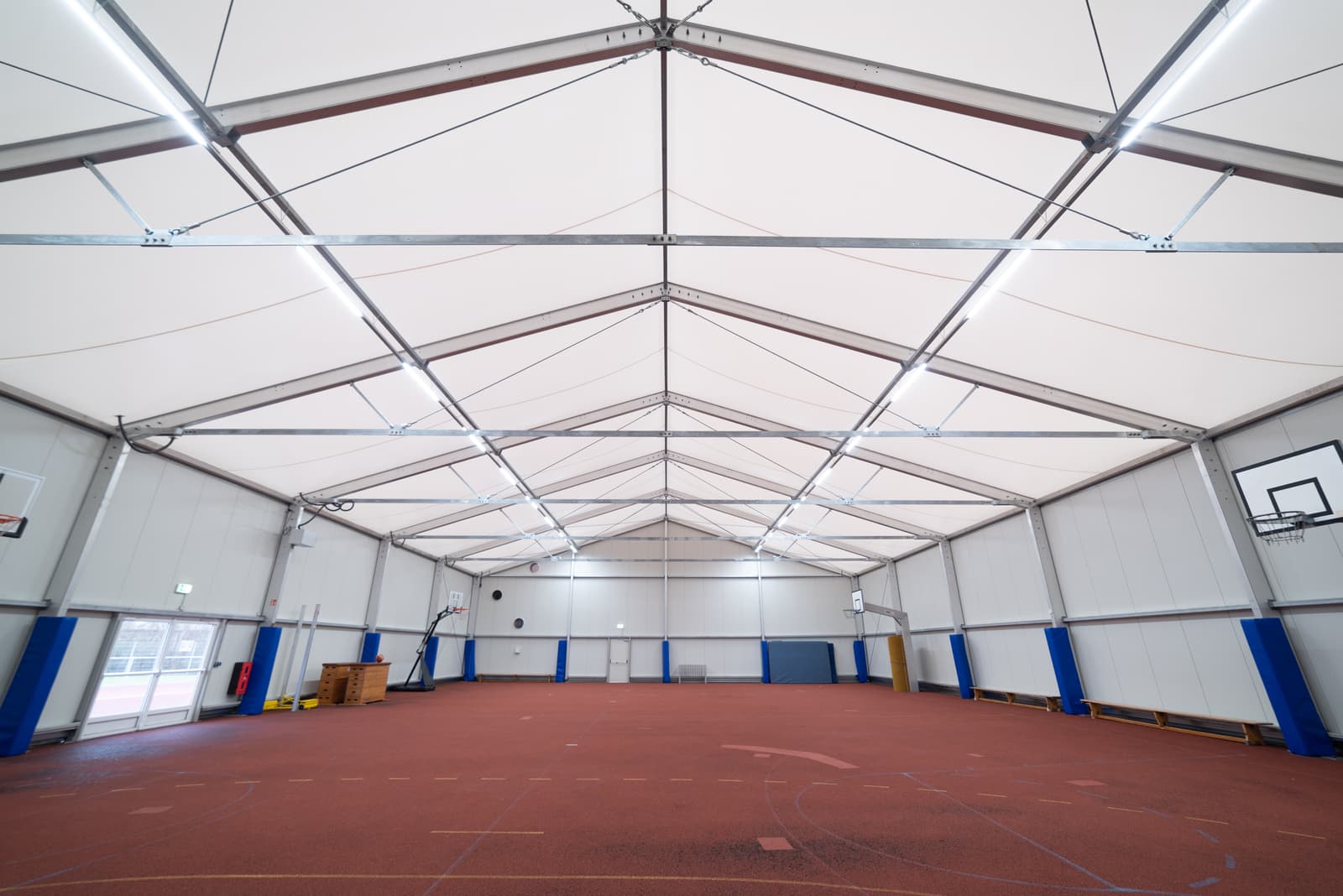
Temporary buildings are also referred to as system or tent buildings. They feature a modular construction, which makes them highly flexible in use. The structure consists of lightweight metal (aluminium frame) and is supplemented with steel components depending on the design. In contrast to solid construction, the lightweight construction results in significantly less weight.
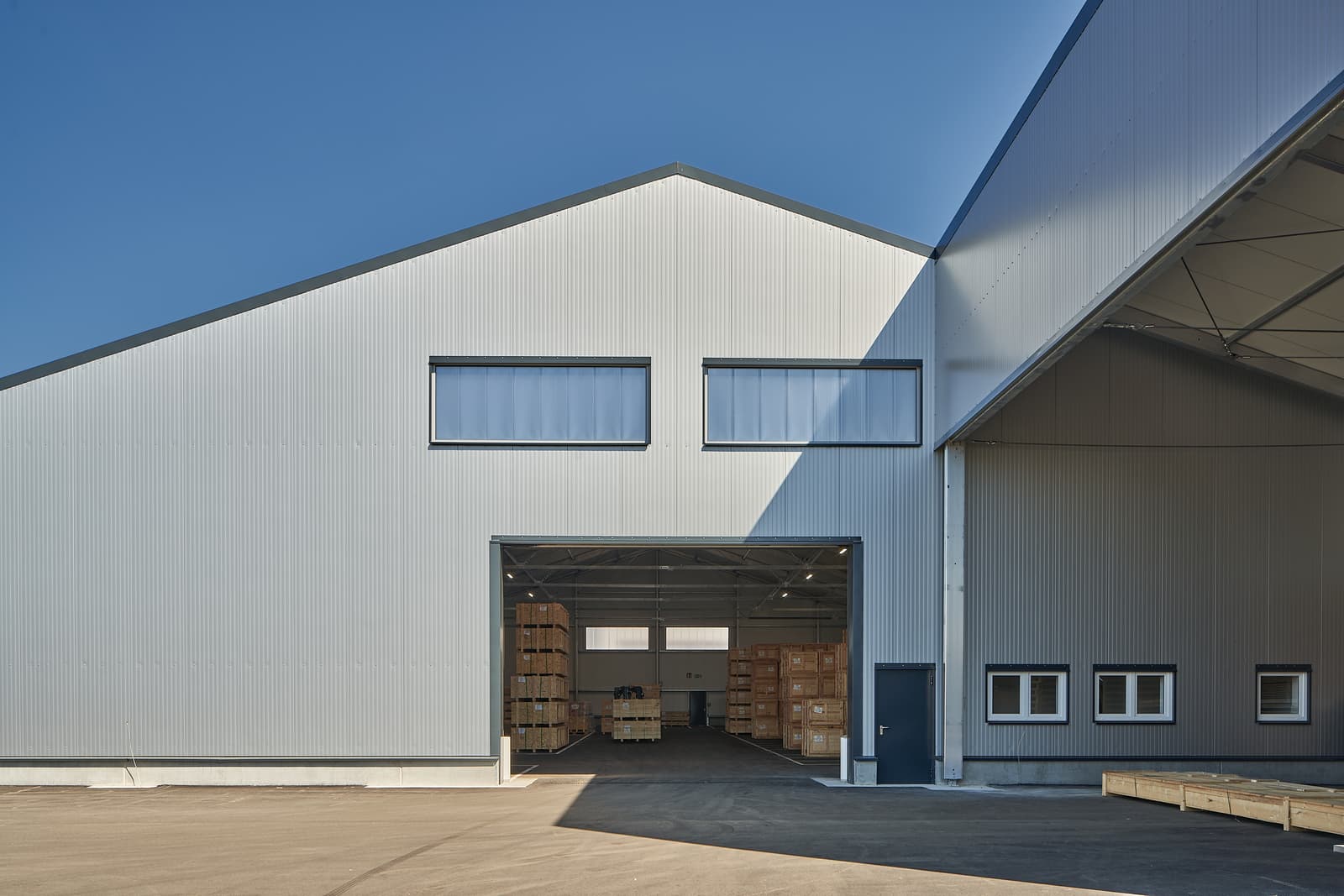
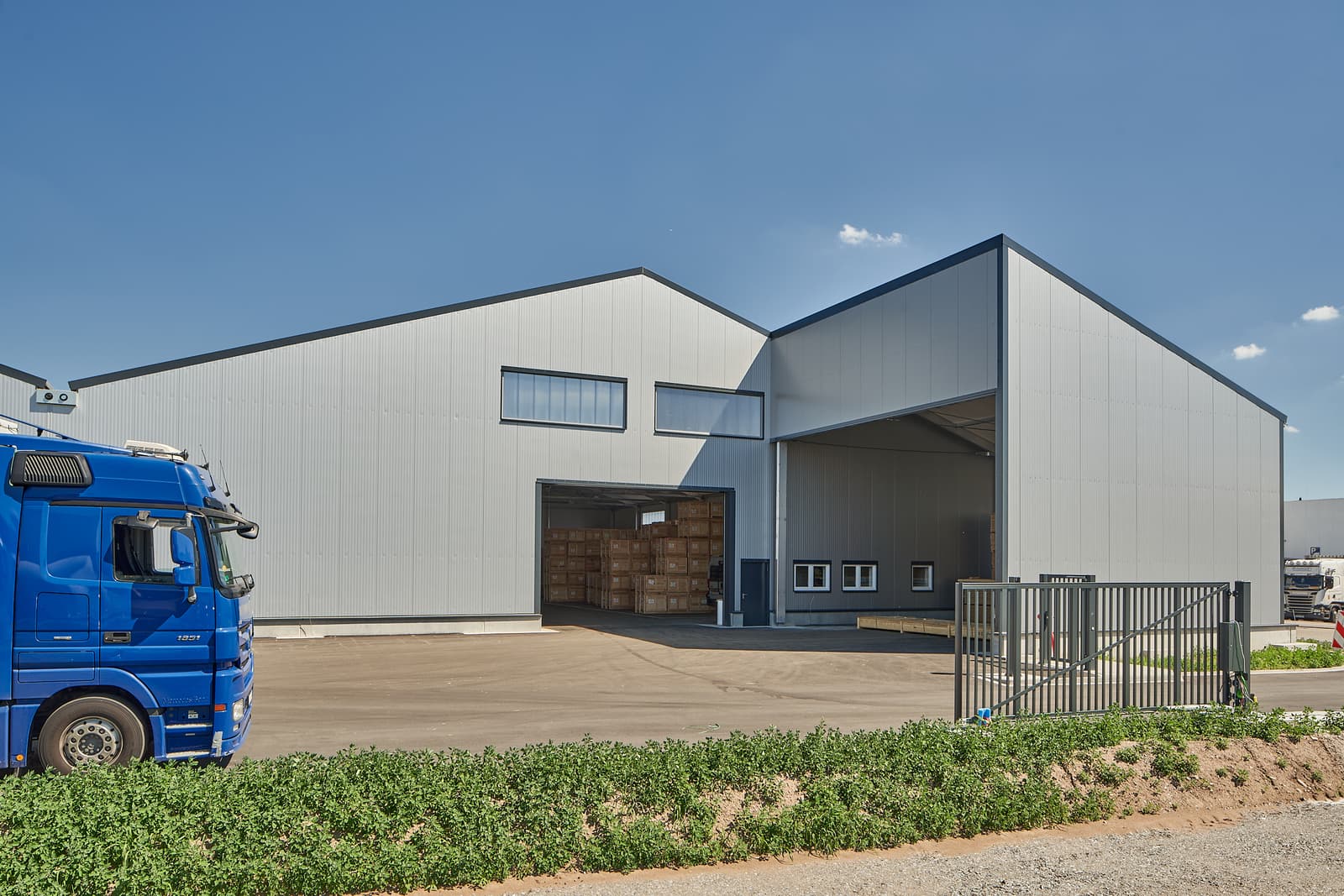
For special requirements or specialised equipment, steel buildings are used. For example, they enable exceptional, column-free spans. Steel buildings provide ideal spatial solutions for trade, industry and commerce whenever aluminium reaches its limits.
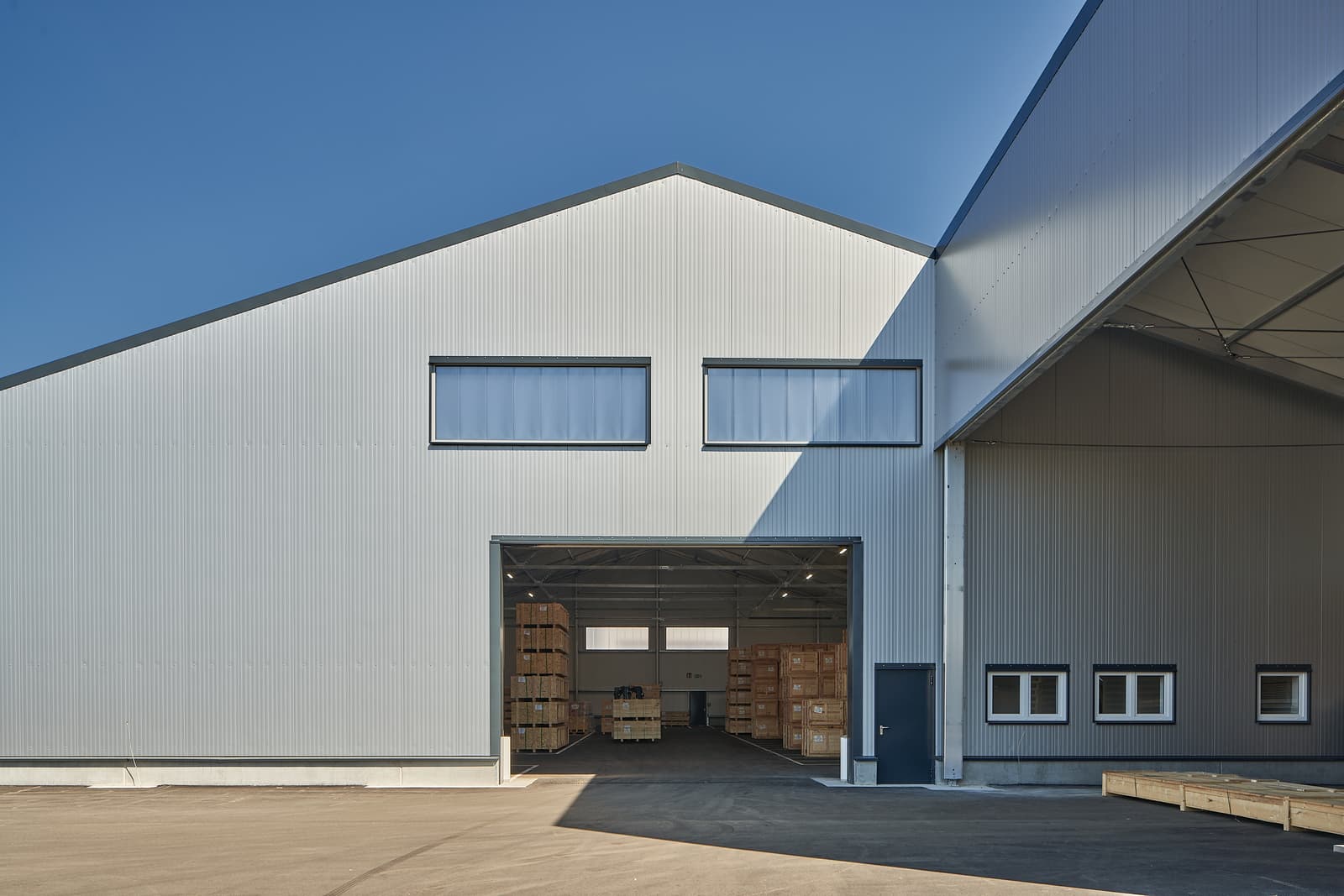
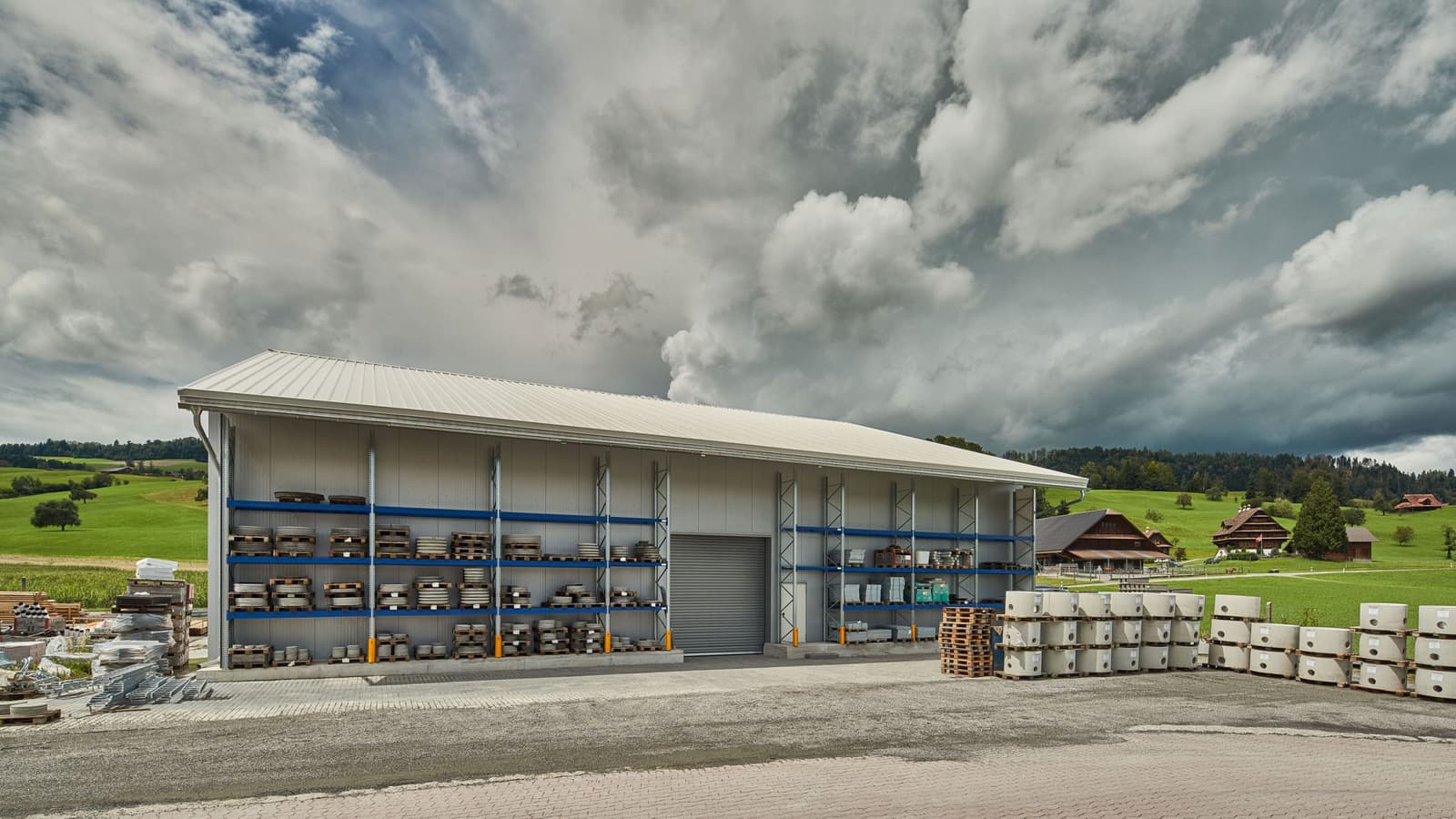
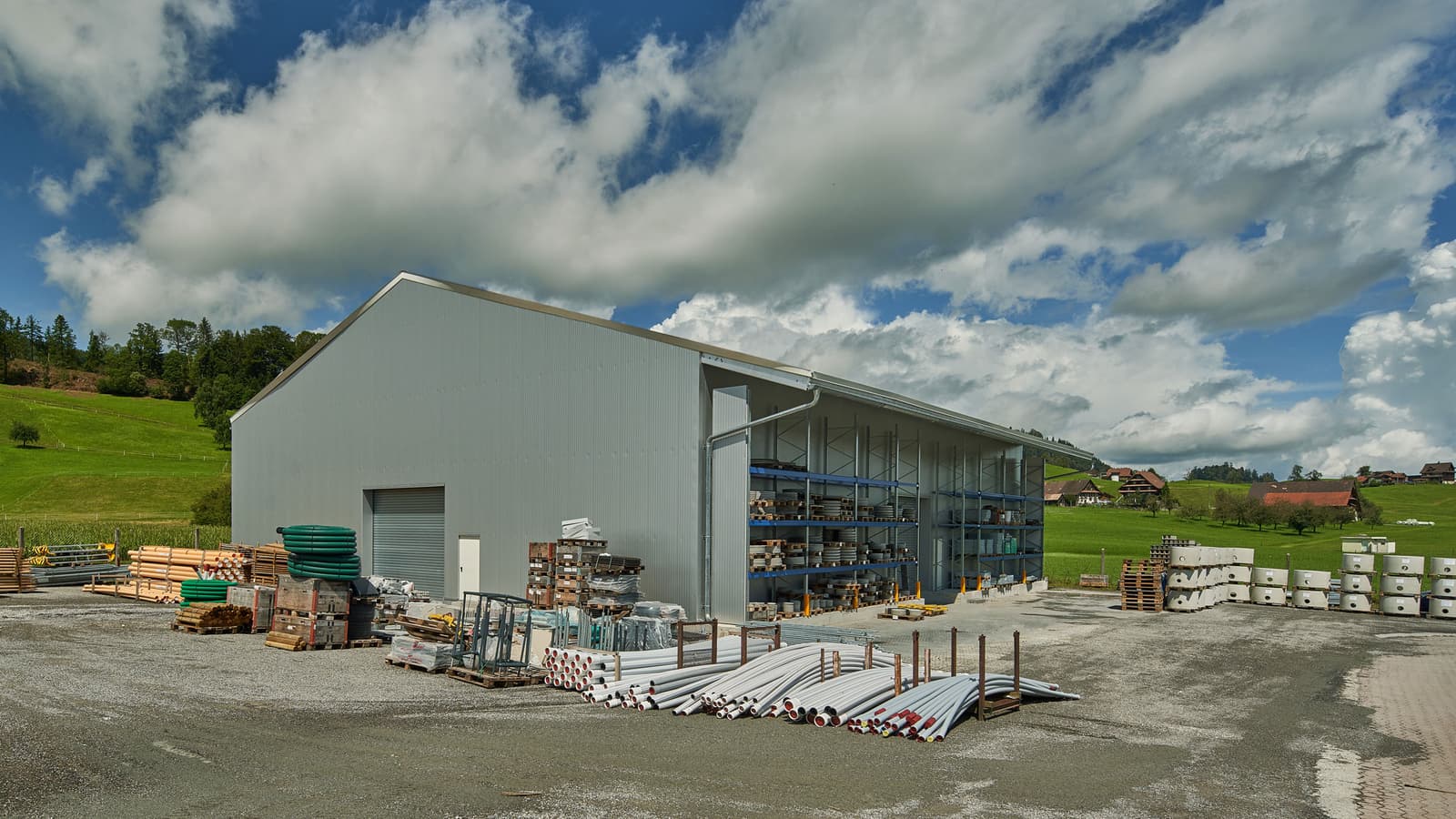
Overview: advantages and disadvantages of temporary buildings and steel buildings
Temporary building | Steel building | |
|---|---|---|
Building material | Aluminium frame | Steel structure |
Construction type | System construction in the form of a modular building kit system, also possible as a permanent construction | System construction, often requiring individual structural analysis |
Delivery time | A few weeks | Several month |
Assembly time | Depending on size and equipment, often within one week | 4 weeks |
Foundation | Not required for “temporary structure” | Required |
Expandability | Yes | Yes |
Dismantling | Easily possible | Difficult and time-consuming |
Reusability | Yes | Yes |
Service life / operational lifespan | Several decades | Up to 50 years |
Recycling | Yes, up to 95% possible | Yes, up to 100% possible |
Building permit | For areas under 75 m², in temporary use as a “temporary structure” for up to a maximum of 3 months, no building permit is required – this regulation can be found in the respective state building regulations | Required |
Materials & properties
Steel has a very high load-bearing capacity, which means large spans and narrow building structures without obstructing supports can be achieved. In addition, the material is easy to work with and very robust.
For lightweight construction, aluminium frames are mostly used. This has the advantage that no groundworks are required to increase load-bearing capacity. At the same time, an aluminium frame is so stable that building regulations and structural safety standards are met worldwide. For temporary buildings, solid roof coverings and wall claddings in insulated or non-insulated form are now also very commonly used; PVC sheeting is only used in a few cases.
Steel is somewhat heavier than aluminium and susceptible to corrosion. With appropriate corrosion protection, this is not a problem. There are different methods for this, such as hot-dip galvanising or coating. Hot-dip galvanising also improves the fire resistance of steel. Aluminium develops a strong self-protective layer against corrosion when exposed to air. In addition, aluminium is a non-combustible building material, although its melting point is lower. Depending on the use of the building, for example in the chemical industry or in production areas with installed sprinkler systems, the use of steel may be the better choice.
Time & installation
A very significant difference between temporary buildings and steel buildings is found in delivery and installation time. A temporary building can be delivered quickly due to its flexible modular system; the delivery time is only a few weeks. Steel buildings are also constructed using a system-based approach. However, the local conditions at the construction site must always be taken into account in the structural calculations. Steel buildings, as well as temporary buildings used as permanent structures, are therefore in many cases bespoke constructions. The delivery time for steel buildings is several months.
Temporary buildings installed as a “temporary structure” do not necessarily require a foundation if they are classified as a “temporary structure” under DIN EN 13782. The aluminium frame can, in most cases, be erected directly on the ground. Suitable surfaces include crushed stone, asphalt, or paving stones. For the construction of a steel building, a foundation is always required.
Temporary buildings also score points in terms of installation time with their fast and straightforward assembly. In many cases, a temporary building can be erected within just a few days. The installation of a steel building takes around four weeks.
Whether a building permit is required for temporary buildings depends on the duration of use. For temporary use, temporary buildings may be erected for up to a maximum of three months. In this case, they are classified as so-called “temporary structures”, which must be reported to the building authority but do not require a building permit. Permanent use of a building, regardless of whether it is lightweight construction or steel construction, always requires a building permit with structural calculations in accordance with DIN EN 1991.
Sustainability & reusability
Steel structures are suitable for permanent use and therefore have a long service life. At the end of the lifecycle of a steel building, the material can be easily and without loss of quality recycled. Steel is thus 100 per cent recyclable. The same applies to the lightweight metal aluminium. Like steel, it has a service life of several decades before the majority of it can be recycled. For these reasons, both metals are highly convincing in terms of sustainability.
Steel is very robust and heavy. This brings many advantages, but also some disadvantages when it comes to dismantling. The dismantling and reassembly of steel buildings is very time-consuming, not least because they are joined not only by bolted connections but also by welded joints.
The simple assembly of temporary buildings allows for equally easy dismantling and reassembly at another location. Temporary buildings can therefore be reused without any reduction in material quality.
Prices & costs
A major factor in the decision between a temporary building and a steel building is, of course, acquisition costs. Here, temporary buildings clearly have the advantage. It is not only the materials used that lead to the significant price difference, but also the easy installation and the fact that no foundation is required for a “temporary structure”. Since temporary buildings can also be erected and dismantled without damage, there is also the option to rent them.
A steel building cannot do without a foundation; typically, a concrete slab is required for this. However, transport and installation costs are also significantly higher for steel buildings than for lightweight aluminium structures.
Get a precise cost estimate for your individual building requirements now.
Applications
Steel buildings and temporary buildings are available in both uninsulated and insulated versions, and a heating system can also be integrated. This means that the range of applications for temporary buildings and steel buildings extends far beyond their classic use as an ideal logistics solution for storage and depot facilities.
Thanks to their flexible and modular system, temporary buildings can be quickly expanded and adapted. They are also suitable for both permanent and temporary use. This makes temporary buildings the ideal solution for temporary space requirements, for example as temporary covering structures. However, the construction is equally designed for long-term use over several decades and is suitable for use as industrial buildings.
Steel buildings are very robust structures that require a foundation. Although changes to the building size are possible, they are somewhat more complex and more difficult to implement than with temporary buildings.
Temporary buildings and steel buildings are used, for example, as:
- sales building
- multi-purpose building
- office building
- exhibition building
- assembly building for machines and equipment
- production building
- workshop building
- loading building
- barn facilities
- hangar
- temporary classrooms
Temporary buildings and steel buildings in comparison: conclusion
The fast availability, rapid installation and highly flexible modular system make temporary buildings the perfect solution for short-term space shortages. Extensions are also possible at any time. Anyone needing an industrial building for a limited period is very well served by temporary buildings. Dismantling and reassembly at another location are also unproblematic for a temporary building. In this case, they offer the best price-performance ratio. However, even for permanent use, temporary buildings are a more cost-effective alternative. In such cases, structural calculations for permanent construction are also required, and therefore a foundation is needed.
Steel is the all-rounder in building construction: whether very slender structures or large spans – the load-bearing capacity of steel is unrivalled. With inserted mezzanine floors and partition walls, additional space for the integration of offices or social and changing rooms can easily be created. Compared to solid construction, steel also scores with low material usage and a comparatively fast construction time of just a few months.